
Manufacturing Business Valuation Services in Winnipeg
Independent business valuation, equipment appraisal, and transaction advisory services for manufacturing businesses across Winnipeg and Manitoba.
Manufacturing businesses carry distinct valuation complexities — capital-intensive equipment, inventory management, customer concentration, margin variability, and supply chain dependencies. Acadia Hill brings the industry-specific analysis required to produce valuation conclusions that accountants, lawyers, and lenders can rely on.
Advisory Services for Manufacturing Companies
Manufacturing businesses often require professional advisory services across several situations — not just when selling. Acadia Hill provides integrated support across valuation, appraisal, transaction, and planning work, so manufacturers work with one advisor who understands the full picture.
Manufacturing Business Valuations
Independent valuation reports for manufacturing companies, prepared by a Chartered Business Valuator. Used for selling a business, shareholder changes, estate freezes, tax planning, and internal strategic decisions. Our business valuation services account for the equipment intensity, inventory requirements, and margin variability common across manufacturing operations.
Machinery & Equipment Appraisals
Manufacturing businesses often hold significant value in production equipment, tooling, and specialized machinery. Lenders frequently request equipment appraisals when evaluating collateral, and they are also required for insurance, financial reporting, and transaction support.
Transaction Advisory
Confidential guidance when buying or selling a manufacturing company. From pre-transaction valuation work through deal structuring, confidential information memorandum development, and negotiation support — our transaction advisory team works alongside your legal and accounting team to move the deal forward.
Business Plans for Financing
Structured business plans and financial projections for manufacturing companies seeking bank financing, equipment acquisition loans, or planning a major capital investment. Built around your actual operating model and production economics — not generic templates.
Unique Factors in Valuing a Manufacturing Company
Valuing a manufacturing business requires more than applying a standard earnings multiple. The sector’s financial profile — capital intensity, inventory risk, customer concentration, and margin volatility — demands industry-specific analysis.
Equipment & Machinery Value
Manufacturing operations typically carry substantial value in production lines, CNC machines, presses, and specialized tooling. Book value rarely reflects fair market value, making an independent appraisal critical to an accurate valuation conclusion.
Customer Concentration
Many manufacturers rely on a small number of key accounts for the majority of revenue. High customer concentration increases risk and often reduces the value a buyer is willing to pay.
Inventory & Work-in-Progress
Raw materials, work-in-progress, and finished goods inventory represent significant working capital. Inventory valuation methods, obsolescence risk, and turnover rates all affect the valuation conclusion.
Margin Variability
Input costs, labour rates, and pricing power can shift sharply in manufacturing. A proper valuation normalizes for margin volatility rather than relying on a single year’s results.
Owner & Key Person Dependence
Many manufacturing businesses rely heavily on the owner or a small number of key employees for customer relationships, production knowledge, or quality control. High dependence typically reduces transferability and value.
Supply Chain & Sourcing Risk
Dependence on single-source suppliers, import reliance, or volatile raw material markets introduces risk that must be assessed and reflected in the valuation.
Production Equipment Often Represents Significant Value
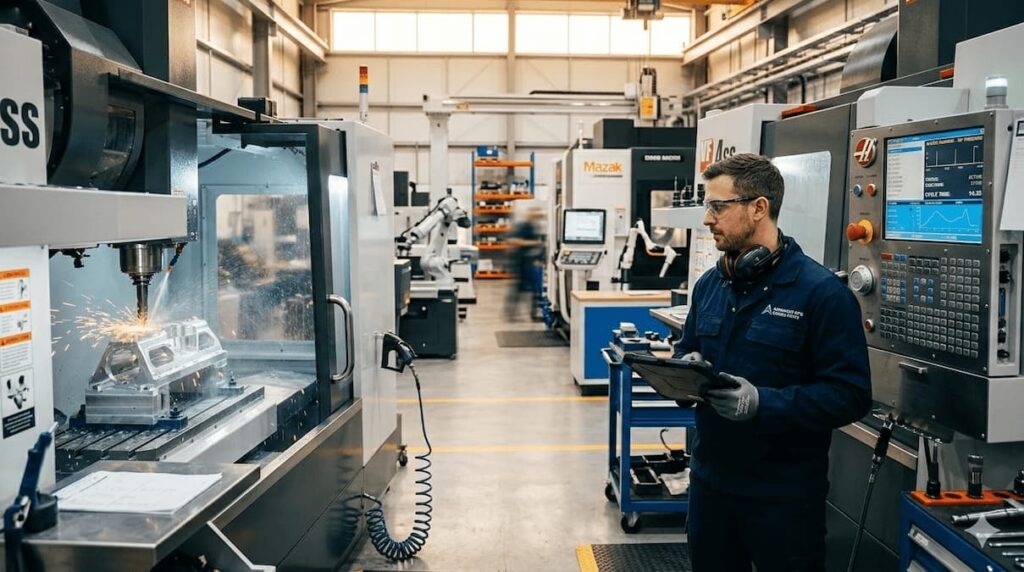
In many manufacturing businesses, the fair market value of production equipment — CNC machines, lathes, milling machines, presses, welding systems, packaging lines, and specialized tooling — represents a material portion of total enterprise value. Depreciated book value on financial statements rarely reflects what this equipment would actually sell for on the open market.
In many cases, a machinery and equipment appraisal is performed alongside the business valuation to determine the fair market value of manufacturing assets. This ensures the valuation conclusion is grounded in actual asset values rather than accounting estimates.
Common manufacturing equipment appraised includes CNC machines, lathes, milling machines, hydraulic and mechanical presses, injection moulding machines, welding and fabrication equipment, packaging and assembly lines, forklifts, overhead cranes, compressors, and specialty production tooling.
Common Situations
Supporting a business valuation with verified asset values
Providing collateral documentation for lenders
Establishing insurable values for production equipment
Supporting asset allocation in a business sale
Estate and tax planning where equipment value is material
Financing applications for equipment acquisition
When Manufacturing Companies Seek Advisory Services
Most manufacturing business owners reach out when a specific event creates a need for professional-grade analysis. These are the situations we see most often.
Preparing to Sell the Business
Need to understand value, prepare marketing materials, and find qualified buyers for the operation.
Bringing in a Partner or Investor
Establishing fair value before adding a shareholder, bringing in outside capital, or restructuring ownership.
Estate Freeze or Tax Planning
Accountant requires an independent valuation for a freeze, reorganization, or Section 85 rollover.
Financing & Capital Investment
Lender requesting a business plan, equipment appraisal, or financial projections to support a loan or equipment acquisition.
Shareholder Disputes
Independent valuation needed to support a buyout, mediation, or litigation file between co-owners.
Succession Planning
Planning the transition of a manufacturing business to family members, key employees, or outside buyers.
Types of Manufacturing Businesses We Work With
Acadia Hill provides valuation, appraisal, and advisory services to a range of manufacturing and production businesses across Winnipeg and Manitoba.
Metal Fabrication
Custom and production metal fabrication shops with welding, cutting, forming, and finishing capabilities.
Food & Beverage Manufacturing
Food processing, packaging, and beverage production operations with specialized equipment and regulatory requirements.
Plastics & Composites
Injection moulding, extrusion, thermoforming, and composite manufacturing businesses.
Wood & Building Products
Millwork, cabinet shops, truss plants, and building materials manufacturing operations.
Machine Shops
Precision machining, CNC turning, milling, and grinding operations serving industrial and commercial customers.
Printing & Packaging
Commercial printing, label manufacturing, packaging production, and related finishing operations.
Industrial Equipment Manufacturing
Businesses designing and building industrial machinery, components, and systems for commercial customers.
Contract Manufacturing
Third-party production operations manufacturing components or finished goods under contract for other companies.
Typical Information Required
Most manufacturing valuation and appraisal engagements can be scoped quickly once we understand the business and the purpose of the work. The information below is typical — not all items are required for every engagement, and we will guide you through what is needed for your specific file.
If financial records need some cleanup or if inventory and equipment schedules are not fully current, that is common with manufacturing businesses and does not prevent the engagement from moving forward.
Documents & Information
Financial statements (3–5 years)
Corporate tax returns
Equipment and machinery list with approximate values
Inventory summary by category (raw, WIP, finished)
Major customer list and revenue concentration
Shareholder and ownership structure
Key supplier and sourcing details
Why Work With a Chartered Business Valuator
The CBV designation is Canada’s recognized professional credential for business valuation. When a valuation needs to support a tax position, a legal matter, a financing application, or a negotiation, the credentials and methodology behind the opinion matter as much as the conclusion itself.
Independent, Defensible, Practical
Acadia Hill prepares valuation work that holds up under scrutiny — from CRA, from opposing counsel, from lenders — while remaining clear enough for business owners to understand and act on. The goal is not just a number, but a well-reasoned opinion that the client and their advisors can use with confidence.
For manufacturing businesses specifically, the combination of business valuation and equipment appraisal expertise under one firm eliminates the coordination issues that arise when multiple independent providers are involved.
Credentials That Matter
Independent valuation opinions prepared by a CBV are accepted by accountants for tax filings and estate work, by lenders for financing decisions, and by legal professionals for dispute resolution and litigation support.
Manufacturing Business Valuation FAQ
How much does a manufacturing business valuation cost?
Most manufacturing business valuations start at $4,000 for a calculation-level report. Final pricing depends on the complexity of the operation, the number of entities involved, inventory considerations, equipment intensity, and the purpose of the engagement.
How long does a manufacturing business valuation take?
Many files are completed within two to four weeks once financial information is received. More complex engagements — multi-entity structures, disputes, or files requiring extensive inventory and equipment analysis — may take longer.
Can the equipment be appraised at the same time?
Yes. In many manufacturing valuation files, a machinery and equipment appraisal is performed alongside the business valuation. This provides verified asset values for production lines, CNC machines, and other capital equipment that strengthen the overall valuation conclusion.
Do lenders accept your appraisal reports?
Yes. Independent equipment appraisals prepared by Acadia Hill are commonly accepted by banks, credit unions, and other lenders when evaluating collateral for business loans, lines of credit, and equipment financing.
How is inventory handled in a manufacturing valuation?
Inventory is analyzed by category — raw materials, work-in-progress, and finished goods — with attention to turnover rates, obsolescence risk, and whether stated values reflect realizable market value. Inventory adjustments are a routine part of manufacturing valuations.
What if we have high customer concentration?
Customer concentration is one of the most common risk factors in manufacturing valuations. Acadia Hill quantifies this risk and reflects it in the valuation through adjusted discount or capitalization rates, ensuring the conclusion accounts for the actual risk profile of the business.
Can you value a manufacturing company that is mostly owner-operated?
Yes. Owner-dependent manufacturing businesses require careful normalization of owner compensation, personal expenses, and related-party transactions. These adjustments are a routine part of valuation work for owner-operated manufacturers.
Do you work with my accountant or lawyer on the file?
Yes, and we prefer it. Most valuation and transaction files involve coordination with the client’s existing accountant and lawyer. Acadia Hill integrates into your professional team.
Discuss Your Manufacturing Business Advisory Needs
Whether you are planning a sale, responding to an accountant or lawyer’s request, or need an equipment appraisal for financing — the first step is a confidential conversation. No obligation.
- Phone 204-951-4751
- Email [email protected]
Manufacturing business owners planning a sale or transition, accountants supporting estate freezes or tax reorganizations, lawyers handling shareholder disputes, and lenders requiring independent equipment or business value opinions.
Tell Us About Your Manufacturing Business
Complete the form below and Acadia Hill will follow up to discuss your file — typically within one business day.